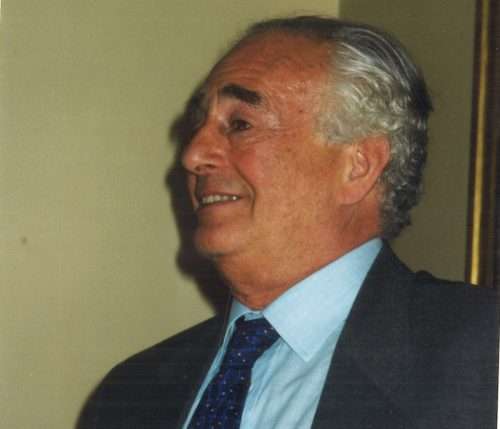
As a young troop commander in the Queen’s Gurkha Engineers John H Edwards (C3 1946-50) was posted to Malaya during the Emergency (1948-1960). Tasked with creating helicopter landing pads and tracks between the infantry bases for resupply and reinforcement, his closest shave was not through action with the Communist Terrorists but was when carrying out a reconnaissance flight for a proposed landing pad. Bad weather closed in quickly, and the pilot of the Auster spotter plane became completely disorientated over the jungle. Keeping a cool head, John instructed the pilot to fly as close to the treetops as possible, knowing they must soon come across a road. Eventually finding a road, they were then able to read the signposts and find their way back to camp.
In 1969 after Army Staff College at Shrivenham and Camberley, John was posted back to Hong Kong to Command 68 Gurkha Independent Field Squadron. China was then in the grip of the Cultural Revolution, and there was much tension between the People’s Liberation Army and British forces. The Squadron’s main role was to support the Infantry who were manning gun emplacements along the border between Hong Kong and Communist China. On one occasion one of the troop’s Commer tippers was on a border task when it came off a narrow, embanked road, spilling its load of sand over a paddy field only fifty metres from the border fence. Soon the local head man was on the scene, demanding compensation, and accusing the Gurkha driver of making eyes at his female workers in the field. The Hong Kong Police became involved, and soon John came under a lot of heat from the Brigade Commander. He kept calm, and much to the gratitude of his young Troop Commander, a military recovery truck was ordered to be brought in to retrieve the tipper. However, that sank up to axles in thick mud and again, thinking quickly, one of the Troop’s heavy duty D4 bulldozers was pulled away from another task nearby to complete the recovery, thus diffusing the situation.
Early in his military career John had given a presentation to then Maj-General Edwin Bramall (later Field Marshall, obituary The Times, 12th Nov 2019) . Bramall was so impressed that he offered John a promotion, but thinking it was said in jest it was tactfully declined. Several years later, and after John’s promotion to Lt. Col and back in Hong Kong as Commandant of the Gurkha Engineers and Commander Royal Engineers Hong Kong the two met again. Bramall was again impressed by John, but on hearing he was the Commandant declared ‘You can’t possibly be – you’re far too young!’
In 1978, as a fluent Nepali speaker, John was appointed Defense Attaché to the British Embassy in Kathmandu, Nepal, a posting which allowed him to undertake several treks to the remoter parts of the country, ostensibly to oversee recruitment and check on the welfare of retired Gurkhas, but also to keep an eye on foreign influence from the Soviets and the Chinese. Often these treks were long and arduous using mountain paths and passes, and to raise the least interest they were undertaken wearing locally made clothes, and with just two porters to share the burden of provisions. Back in Kathmandu on the Embassy circuit John scored a notable diplomatic coup – the Chinese and Soviets were not on good terms with each other at this time, and their respective Defense Attachés in Kathmandu were under strict instruction not to attend events, social or otherwise, if their counterpart was going to be there. This was much to the embarrassment of the two Attachés – Kathmandu was, after all, a small community at this time. There therefore emerged an unofficial competition between the other Attaches to see who could be the first to get their Russian and Chinese counterparts together at the same event. On leaving his post John was presented with a fine statue of the Hindhu god Ganesh, engraved with the names of every Military Attaché in Kathmandu, in recognition of his success being the first, and in improving diplomatic relations.
John had married Wendy (nee Rowe) in 1955, but as he was under the age of 25 at that time the marriage wasn’t officially recognized by the Army. It was only in 1958 that they were eligible for married quarters, having previously being registered as ‘living in sin’. They adopted two children, Matthew and Rebecca. Wendy sadly died after a long battle with cancer in 1984.
John’s final posting in 1985 as Brigadier in command of the Brigade of Gurkhas, was very apt as it saw him back in Hong Kong for one final time with the men he had served with for so much of his career. At the time of his retirement in 1987, and with seven tours with the Gurkhas in Hong Kong and Nepal, John was one of the most experienced Gurkha officers at that time.
It was during this time in Hong Kong that John met Jane Pickard, a director of the travel agency Abercrombie & Kent, and they married in 1987. As Jane couldn’t leave her business John, now retired, joined the Royal Hong Kong Yacht Club as General Manager where he enjoyed a second career building on his passion for sailing. As a keen and experienced yachtsman he had taken part in many ocean races in Army yachts, including skippering two Fastnet races and two China Sea races. On one occasion at the Club he was checking the premises with the Commodore during a heavy monsoon down pour. They encountered one of the staff, a Mr To, wearing a black bin liner with holes cut for arms and head. ‘Surely we can afford to buy him proper wet weather gear?’ the Commodor asked, ‘we can, and we have’ replied john ‘but he won’t wear it. He simply prefers his bin liners and refuses to wear anything else’. An illustration of John’s understanding, empathy and tolerance of those working for him.
1993 John retired with Jane to their home in Westerham, Kent, where he helped develop the Gurkha Welfare Trust, the country wide fund-raising organization to aid Gurkha veterans, their families and communities in Nepal and the UK. He was Chairman of the Parish Council from 2001 – 2005, and Chairman of the Westerham Branch of the RNLI. He and his RNLI team raised many thousands of pounds for the charity, earning John the RNLI’s ‘Thanks of the Institution on Vellum’ in recognition of his services to that Institution.
During his time as Chairman of the Parish Council there was a campaign by a group of vocal residents to put up a fence around the statue on the green in Westerham of Sir Winston Churchill, – a notable local landmark, to stop people climbing on it. However, as a grandfather John had watched his own grand daughter enjoy climbing over the statue. Knowing there was more to this he researched the Council archives, and was able to find a letter from Oscar Nemon, the statue’s sculptor who made several sculptures of Churchill. In it he wrote ‘I intend to make the sculpture massive so that children may climb on it’. The residents were silenced, and children enjoy climbing on the statue to this day.
A keen golfer, he represented Tandridge Golf Club in senior competitions, and as sailors he and Jane cruised their yacht extensively around the South and East coasts and into European waters.
John Hyde Edwards was born in Shilong, northern India, in 1933 to Noel Edwards and Wilheminia Bowen-Powell. His father, uncle and grand-father had all been officers in Gurkha regiments. As a cadet at military academy his father had won on merit the Sandhurst Sword and served as a commander with the Gilgit Guides in Northern Pakistan, at that time an extremely remote posting. His elder brother Colin fought with the Royal Engineers in the North Africa campaign of World War Two, spending much of the war a prisoner first in Italy (where he made several unsuccessful escapes), and then in Germany. Indeed, it was only a photograph of a camp liberation being published on the cover of The Telegraph that alerted his family to his survival. His maternal grandfather was Eyre Burton Powell (1819–1904), whose statue is in Presidency College in Chennai, India, where he served as the founding principal. After his father’s early death from malaria John was brought back to England and was educated at Marlborough College before going to Sandhurst and being commissioned into the Royal Engineers. It was perhaps inevitable that he would follow into the Gurkha Regiments, where he would be the third member of his family to carry the same military sword.
He died aged 92 on March 24th, 2025, and is survived by his second wife Jane, and his two children from his first marriage.